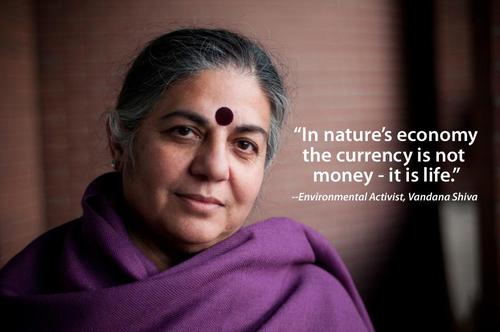
Showing posts with label Vandana Shiva. Show all posts

Sunday, April 26, 2015

Paradigms of connectedness for sustainable food systems: food sovereignty, agroecology, permaculture, indigenous values and 'working with nature'

This is based on a presentation I did a few weeks ago at am interdisciplinary conference at Massey University, on 'Working with Nature'. The second part of it is quite similar to the last presentation I posted, because I still think it's a good idea.


Western thought is dominated by false dichotomies, perhaps none is more pervasive or absurd than the one separating human beings from ‘nature’.   Whereas ‘nature’ was once a wilderness to be tamed, the mainstream perspective has shifted to perceive it as precious, fragile and in need of our protection. This view does not allow any room for human beings to exist within nature, and yet, scientifically, it is impossible to see us in any other way. What lies at the heart of this problem is a fracture in dominant Western theory which has resulted in ontologies of violence, alienation and disconnection. These have potentiated many of humanity’s most embarrassing historical episodes of social and environmental exploitation. In order to begin to remedy these issues, interconnectedness with ‘nature’ must be recognised in terms of social, economic and environmental ecosystems. In recent years, food, an integral part of culture and daily life, has become increasingly politicised, in relation to globalising corporate capitalism as well as with local struggles for food sovereignty. This presentation draws on the indigenous Māori value of whakapapa, which can be described as the journey of things through space and time as well as three paradigms of connectedness which are relevant to food production: permaculture, agroecology and food sovereignty.  These paradigms are all examples of ‘working within nature’, rather than against it. They are all compatible with each other and overlapping. Each has been developed with careful reflection regarding the function of complex ecosystems and indigenous knowledge, and are based on ontologies of connectedness in juxtaposition to globalising capitalism’s ontology of alienation.  These theoretical strands are illuminated by ethnographic reflections from my doctoral fieldwork focussed on local food and food sovereignty in New Zealand.  I argue that genuine pathways to sustainability and resilience are only possible through agricultural models based on ecosystems and indigenous knowledge systems, and through the proliferation and support of small-scale community initiatives.

According to Plato Heraclitus and Parmenides once had an argument over a river. Parmenides said it was a static thing. Heraclitus said it was constantly changing. Parmenides won and went on to inspire dominant Western philosophers theory, particularly the philosophers who lead to the creation of modern science, such as pythagoras.


This is one way of telling a story about a rift in Western philosophy - and  of the subsequent fracturing that has allowed us to become more and more disconnected from 'nature', from our ecosystems, and from ourselves.

 Heraclitus went on to feature in motivational posters:


He also inspired the philosophical tradition followed by Hegel, Marx and Friere, among others.

This tradition is less black and white than ‘logic’, it is more holistic and tends to integrate rather than just dismiss different perspectives.

This is the tradition I was unknowingly drawn to, possibly by intuition, possibly because it reflects my upbringing and the emersion in indigenous Māori culture I experienced as a young child.

 This separation, and countless other examples of fracturing discourse has precipitated a perspective of human beings as separate to nature – culminating in gross distortions
•Of our significance
•Of our relationship to the world

Older ideas of Taming nature have given way to more recent notions of saving the world.

We may be incapable of seeing “nature” accurately, but “nature as separate” is a very strange concept, to begin with.


There is no word in Māori for nature as separate from humans.

There is no word for “Wilderness” in many languages.

Indigenous perspectives tend to be much more inclusive and interconnected.

The concept of “nature” as separate from “human beings" is essentially alienating and embarrassingly (ironically) unscientific


What we can be sure of is that we are facing major challenges to our survival, as a species, and this awareness could potentially lead to doing things better.

Looking out the window of a plane, have you ever noticed how much land is used for our food production?

We have shaped large chunks of this planet into our personal bread-basket. 

If we are going to start ‘working with nature’ this is a good place to focus

A critical perspective is important here…

While there is plenty to be critical of, it is also helpful to look for solutions, to find working models and inspiration.

Genuine sustainability must come from the grass-roots, upward. It must be holistic and multi-faceted.

Economic, social and environmental – genuine sustainability is synonymous with healthy interconnected ecosystems.


Agroecology comes from ecology – from the ‘natural sciences’ – it takes an ecological approach to agriculture. 

A whole-systems approach to agriculture and food systems development based on traditional knowledge, alternative agriculture, and local food system experiences.

Linking ecology, culture, economics, and society to sustain agricultural production, healthy environments, and viable food and farming communities.


Sparked in 1996 by Vía Campesina, an international peasant movement representing more than 180 international organisations advocating for peasants, migrant agricultural workers, indigenous food providers and small-scale farmers.
•Producing food for people, not for the global commodity market
•Valuing food producers
•Localising food systems
•Local control over resources
•Building skills and knowledge

•Working with Nature


Bill Mollison:
Permaculture is a philosophy of working with, rather than against nature; of protracted and thoughtful observation rather than protracted and thoughtless labor; and of looking at plants and animals in all their functions, rather than treating any area as a single product system.

Permaculture (permanent agriculture/culture) is the conscious design and maintenance of agriculturally productive ecosystems which have the diversity, stability, and resilience of natural ecosystems

Consciously designed landscapes which mimic the patterns and relationships found in nature, while yielding an abundance of food, fibre and energy for provision of local needs.


It is a system which can be applied to anything – society/community, economics…

Local food map by Te Mauri Tau

Whaingaroa (Raglan)
•Whaingaroa is a dynamic community engaged in activities related to food sovereignty. 
•Groups and initiatives are closely interconnected. 
•Strong focus on ‘local’, ‘organic’, ‘sustainable’
•There is still a long way to go.
•Supermarket culture: a lot of food is still purchased from the town supermarkets or from Hamilton
•Not enough local food producers yet (more coming?)

•Poverty and social exclusion vs the ‘green bubble’


 •Interconnectedness is key
•Food sovereignty is about relationships

Gardens at Kaiwhenua Organics

What can we learn from the local food producers of Whaingaroa?
•People can lead incredibly rich lives without much material wealth
•Balancing the economic, social and environmental  - and viewing them as interconnected
•Strong critiques of the corporate food system: control, ecological damage and exploitation
•People have gotten too disconnected from food: need to reconnect, Food needs to be real
•The right to have access to food…
•Food should be: local, sustainably produced, safe and abundant.
•Supporting local food producers: avoiding competition, working together
•Respecting indigenous values, learning from indigenous wisdom


•Indigenous systems have been developed alongside ecological systems – necessarily –
•We can learn a lot from ecological systems, from the indigenous knowledge systems in our local landscape

•Without considering the flows and cycles of ecosystems, without considering ourselves part of them, we cannot move past sustainability as a catchword


Through understanding the interconnectedness we can repair fragmented ontologies, heal rifts and avoid environmental, social and economic exploitation.

Tuesday, December 2, 2014

Vandana Shiva and Monocultures of the Mind


I'm so excited Vandana Shiva is coming to New Zealand for the food conference in February. I absolutely love her work. One of my supervisors asked me to write a bit about Shiva as I'm looking at using her writing as theory in my thesis. This is what I wrote:

Vandana Shiva is both a geneticist and an environmental activist and thinker. Her work is particularly focussed on threats to biodiversity and the impacts of biotechnology (Shiva 2005, 2012).  In Earth Democracy (2005) Shiva is outspoken against corporate globalisation which destroys grassroots democracy through “new enclosures of the commons” which are based on violence:
Instead of a culture of abundance, profit-driven profit driven globalization creates cultures of exclusion, dispossession and scarcity. In fact, globalization’s of all beings and resources into commodities robs diverse species and people of their rightful share of ecological, cultural and political space. The “ownership” of the rich is based on the “dispossession” of the poor. It is the common public resources of the poor which are privatised, and the poor who are disowned economically, politically and culturally (2005, 2).

Shiva is particularly critical of the patenting of genetics and the concept of ‘ownership’ of life and the rhetoric of ‘ownership society’ which she describes as ‘anti-life’. She argues that from this perspective living things have no intrinsic value and no integrity.  She argues that the commons are the “highest expressions of economic democracy” (2005, 3). She also describes the movement against corporate globalisation as one toward ‘Earth Democracy’ the fate of which concerns the wellbeing of all living beings on earth. She describes an intentional shift from “vicious cycles of violence in which suicidal cultures, suicidal economies and the politics of suicide feed on each other to virtuous cycles of creative non-violence in which living cultures nourish living democracies and living economies (sharing resources equitably to create meaningful livelihoods)” (2005, 5). 

Earth Democracy, then is not just a concept but incorporates diverse practice reclaiming commons, resources, livelihoods, freedoms, dignity, identity and peace – rooted locally but also interconnected with the world and universe (2005, 5).   Shiva argues that ecological security and ecological identities are our most basic and fundamental: “We are the food we eat, the water we drink, the air we breathe. And reclaiming democratic control over our food and water and our ecological survival is the necessary project for our freedom (2005, 5). Earth Democracy enables us to create living democracies of participation in decisions regarding our food, water and air, systems which are based on intrinsic worth of all aspects of the environment, including people.  It includes the “ancient wisdom and tradition of non-severability and interconnectedness” along with “the values, worldviews and actions of diverse movements working for peace, justice and sustainability” (2005, 7).

In Monocultures of the mind (2012), Shiva discusses the importance of local knowledge systems which are disappearing and being colonised by dominant Western knowledge and the globalising system. She argues that although  Western knowledge has been constructed as universal, it is actually just a globalised version of a local parochial system based in a particular culture, gender and class (2012, 9). Therefore, the common dichotomy between universal and local is misplaced when applied to Western and indigenous traditions because what is perceived as ‘universal’ is actually a local system “which has spread world wide through intellectual colonisation” (Shiva 2012, 10). Shiva argues that a genuine universal knowledge system would spread through openness, whereas the globalising system spreads through violence and misrepresentation, the first level of which is “not to see them (local/indigenous) as knowledge,” but as ‘primitive’ and unscientific (2012, 10).  This undermines local epistemologies, making them invisible and vulnerable to collapse against the force of the uniquely ‘scientific’ and universal Western.  Shiva argues this is actually less connected with knowledge than it is with power:
The models of modern science which have encouraged these perceptions were derived less from familiarity with actual scientific practice and more from familiarity with idealised versions which gave science a special epistemological status. Positivism, verificationism, falsificationism were all based on the assumption that unlike traditional, local beliefs of the world, which are socially constructed, modern scientific knowledge was thought to be determined without social mediation. (2012, 11)

This notion that Western science is somehow objective and devoid of social influence, is something Shiva is highly critical of, along with the conception that the broader Western knowledge paradigm is superior. That Western knowledge is fashioned as scientific “assigns a kind of sacredness or social immunity to the Western system,” which is above the indigenous traditions that it excludes.
Just as intensive corporate farming practices create unsustainable biological monocultures which erode diversity, the dominant scientific paradigm “breeds a monoculture of the mind” (2012, 12) It makes local alternative knowledge systems disappear by destroying the possible conditions required for alternatives to exist.  It does this through its ‘superior’ exclusivity and through a violent separation which destroys diverse local meaning.  Shiva states that in local knowledge systems there is no artificially imposed separation between ‘resources’: “the forest and the field are in ecological continuum” and local agriculture is modelled on forest ecology and both supply food (2012, 14). In contrast the supposedly ‘scientific’ system segregates forestry from agriculture. Forestry is reduced to resources like timber and is no longer connected to food. “Knowledge giving systems which have emerged from the food giving capacities of the forest are therefore eclipsed and finally destroyed, both through neglect and aggression” (2012, 14).  Shiva uses the examples of ‘scientific management’ based on narrow commercial interests and enforced through legislation in India to illustrate her arguments on the destruction of diverse knowledge systems (2012, 18).
The existing principles of scientific forest management leads to the destruction of the tropical forest ecosystem because it is based on the objective modelling of the diversity of the living forest on the uniformity of the assembly line. Instead of society being modelled on the forest, as it is in the case of forest cultures, the forest is modelled on the factory... which transforms the forest from a renewable to a non-renewable resource. (Shiva 2012, 19)

Shiva argues that the dominant knowledge system is inherently colonising and culturally fragmenting in its effects. It alienates knowledge from wisdom.  The political implications of such a system system are fundamentally inconsistent with sustainability, equality and social justice. For these reasons it is a particularly dangevous, violent and destructive monoculture of the mind.  In the face of this reality, Shiva advocates for the democratisation of knowledge as “a central precondition for human liberation because the contemporary knowledge system excludes the humane by its very structure” (2012, 60). She envisions this democratisation involving the redefining of knowledge so that local and diverse become legitimate and indispensable, and globalisation and universalisation are conceived as abstractions which have violated this reality. This shift, according to Shiva, is:
…important to the project of human freedom because it frees knowledge from the dependency on established regimes of thought, making it simultaneously more autonomous and more authentic. Democratisation based on such an ‘insurrection of subjugated knowledge’ is both a viable and necessary component of the larger processes of democratisation because the earlier paradigm is in crisis and in spite of its power to manipulate, is unable to protect both nature and human survival. (2012, 62)

References:
Shiva, V. 2012. Monocultures of the mind: perspectives on biodiversity and biotechnology. New Delhi: Natraj.

Shiva, V. 2005. Earth democracy: justice, sustainability and peace. Brooklyn: South End Press