Showing posts with label research. Show all posts

Sunday, April 26, 2015

Paradigms of connectedness for sustainable food systems: food sovereignty, agroecology, permaculture, indigenous values and 'working with nature'

This is based on a presentation I did a few weeks ago at am interdisciplinary conference at Massey University, on 'Working with Nature'. The second part of it is quite similar to the last presentation I posted, because I still think it's a good idea.


Western thought is dominated by false dichotomies, perhaps none is more pervasive or absurd than the one separating human beings from ‘nature’.   Whereas ‘nature’ was once a wilderness to be tamed, the mainstream perspective has shifted to perceive it as precious, fragile and in need of our protection. This view does not allow any room for human beings to exist within nature, and yet, scientifically, it is impossible to see us in any other way. What lies at the heart of this problem is a fracture in dominant Western theory which has resulted in ontologies of violence, alienation and disconnection. These have potentiated many of humanity’s most embarrassing historical episodes of social and environmental exploitation. In order to begin to remedy these issues, interconnectedness with ‘nature’ must be recognised in terms of social, economic and environmental ecosystems. In recent years, food, an integral part of culture and daily life, has become increasingly politicised, in relation to globalising corporate capitalism as well as with local struggles for food sovereignty. This presentation draws on the indigenous Māori value of whakapapa, which can be described as the journey of things through space and time as well as three paradigms of connectedness which are relevant to food production: permaculture, agroecology and food sovereignty.  These paradigms are all examples of ‘working within nature’, rather than against it. They are all compatible with each other and overlapping. Each has been developed with careful reflection regarding the function of complex ecosystems and indigenous knowledge, and are based on ontologies of connectedness in juxtaposition to globalising capitalism’s ontology of alienation.  These theoretical strands are illuminated by ethnographic reflections from my doctoral fieldwork focussed on local food and food sovereignty in New Zealand.  I argue that genuine pathways to sustainability and resilience are only possible through agricultural models based on ecosystems and indigenous knowledge systems, and through the proliferation and support of small-scale community initiatives.

According to Plato Heraclitus and Parmenides once had an argument over a river. Parmenides said it was a static thing. Heraclitus said it was constantly changing. Parmenides won and went on to inspire dominant Western philosophers theory, particularly the philosophers who lead to the creation of modern science, such as pythagoras.


This is one way of telling a story about a rift in Western philosophy - and  of the subsequent fracturing that has allowed us to become more and more disconnected from 'nature', from our ecosystems, and from ourselves.

 Heraclitus went on to feature in motivational posters:


He also inspired the philosophical tradition followed by Hegel, Marx and Friere, among others.

This tradition is less black and white than ‘logic’, it is more holistic and tends to integrate rather than just dismiss different perspectives.

This is the tradition I was unknowingly drawn to, possibly by intuition, possibly because it reflects my upbringing and the emersion in indigenous Māori culture I experienced as a young child.

 This separation, and countless other examples of fracturing discourse has precipitated a perspective of human beings as separate to nature – culminating in gross distortions
•Of our significance
•Of our relationship to the world

Older ideas of Taming nature have given way to more recent notions of saving the world.

We may be incapable of seeing “nature” accurately, but “nature as separate” is a very strange concept, to begin with.


There is no word in Māori for nature as separate from humans.

There is no word for “Wilderness” in many languages.

Indigenous perspectives tend to be much more inclusive and interconnected.

The concept of “nature” as separate from “human beings" is essentially alienating and embarrassingly (ironically) unscientific


What we can be sure of is that we are facing major challenges to our survival, as a species, and this awareness could potentially lead to doing things better.

Looking out the window of a plane, have you ever noticed how much land is used for our food production?

We have shaped large chunks of this planet into our personal bread-basket. 

If we are going to start ‘working with nature’ this is a good place to focus

A critical perspective is important here…

While there is plenty to be critical of, it is also helpful to look for solutions, to find working models and inspiration.

Genuine sustainability must come from the grass-roots, upward. It must be holistic and multi-faceted.

Economic, social and environmental – genuine sustainability is synonymous with healthy interconnected ecosystems.


Agroecology comes from ecology – from the ‘natural sciences’ – it takes an ecological approach to agriculture. 

A whole-systems approach to agriculture and food systems development based on traditional knowledge, alternative agriculture, and local food system experiences.

Linking ecology, culture, economics, and society to sustain agricultural production, healthy environments, and viable food and farming communities.


Sparked in 1996 by Vía Campesina, an international peasant movement representing more than 180 international organisations advocating for peasants, migrant agricultural workers, indigenous food providers and small-scale farmers.
•Producing food for people, not for the global commodity market
•Valuing food producers
•Localising food systems
•Local control over resources
•Building skills and knowledge

•Working with Nature


Bill Mollison:
Permaculture is a philosophy of working with, rather than against nature; of protracted and thoughtful observation rather than protracted and thoughtless labor; and of looking at plants and animals in all their functions, rather than treating any area as a single product system.

Permaculture (permanent agriculture/culture) is the conscious design and maintenance of agriculturally productive ecosystems which have the diversity, stability, and resilience of natural ecosystems

Consciously designed landscapes which mimic the patterns and relationships found in nature, while yielding an abundance of food, fibre and energy for provision of local needs.


It is a system which can be applied to anything – society/community, economics…

Local food map by Te Mauri Tau

Whaingaroa (Raglan)
•Whaingaroa is a dynamic community engaged in activities related to food sovereignty. 
•Groups and initiatives are closely interconnected. 
•Strong focus on ‘local’, ‘organic’, ‘sustainable’
•There is still a long way to go.
•Supermarket culture: a lot of food is still purchased from the town supermarkets or from Hamilton
•Not enough local food producers yet (more coming?)

•Poverty and social exclusion vs the ‘green bubble’


 •Interconnectedness is key
•Food sovereignty is about relationships

Gardens at Kaiwhenua Organics

What can we learn from the local food producers of Whaingaroa?
•People can lead incredibly rich lives without much material wealth
•Balancing the economic, social and environmental  - and viewing them as interconnected
•Strong critiques of the corporate food system: control, ecological damage and exploitation
•People have gotten too disconnected from food: need to reconnect, Food needs to be real
•The right to have access to food…
•Food should be: local, sustainably produced, safe and abundant.
•Supporting local food producers: avoiding competition, working together
•Respecting indigenous values, learning from indigenous wisdom


•Indigenous systems have been developed alongside ecological systems – necessarily –
•We can learn a lot from ecological systems, from the indigenous knowledge systems in our local landscape

•Without considering the flows and cycles of ecosystems, without considering ourselves part of them, we cannot move past sustainability as a catchword


Through understanding the interconnectedness we can repair fragmented ontologies, heal rifts and avoid environmental, social and economic exploitation.

Saturday, March 14, 2015

Pathways to Sustainability through Food Sovereignty and Agroecology: a Holistic Approach


This post is based on a presentation I did at a sustainability symposium at the University of Waikato a few weeks ago.

Abstract:
Food sovereignty and agroecology have been the focus of much academic attention in recent years, although very little has been published on these topics in a New Zealand context. These paradigms have been instrumental in highlighting multifaceted problems of social and environmental exploitation emerging from the existing industrialised food systems and identifying more sustainable solutions. This presentation draws on preliminary findings from doctoral research focused on food sovereignty in New Zealand. Qualitative data was were gathered through ethnographic fieldwork and in-depth interviews with people who produce, organise and distribute local food in a small coastal New Zealand township, as well as in several contrasting settings. It presents diverse understandings around organic and local food, environmental protection, community resilience and living economies. The findings are that genuine pathways to sustainability are possible through agricultural models based on ecosystems and indigenous knowledge systems, and through the proliferation and support of small-scale community initiatives.

Sustainability has become a catchword…

A linguistic representation of a cultural shift in perspective that has increasingly necessary in the face of emerging global crises – climate, food, waste, energy and inequality

This wave has reached the point where it’s no longer just a few hippies waving placards, it is increasingly ubiquitous


The movement that first became mainstream for my generation with the likes of Captain Planet has now reached critical mass

But does this mean the words are being over-used? Green-washed?

Has sustainability lost meaning? Has it been corporatised?


A critical perspective is important here…

While there is plenty to be critical of, it is also helpful to look for solutions, to find working models and inspiration

Genuine sustainability must come from the grass-roots, upward. It must be holistic and multi-faceted.

Economic, social and environmental – genuine sustainability is synonymous with healthy interconnected ecosystems.


Agroecology is a whole-systems approach to agriculture and food systems development based on traditional knowledge, alternative agriculture, and local food system experiences: linking ecology, culture, economics, and society to sustain agricultural production, healthy environments, and viable food and farming communities. It's also a less ‘hippy’ term for permaculture


Permaculture (permanent agriculture/culture) is the conscious design and maintenance of agriculturally productive ecosystems which have the diversity, stability, and resilience of natural ecosystems

Consciously designed landscapes which mimic the patterns and relationships found in nature, while yielding an abundance of food, fibre and energy for provision of local needs.

It is a system which can be applied to anything – society/community, economics…


Sparked in 1996 by Vía Campesina, an international peasant movement representing more than 180 international organisations advocating for peasants, migrant agricultural workers, indigenous food providers and small-scale farmers.

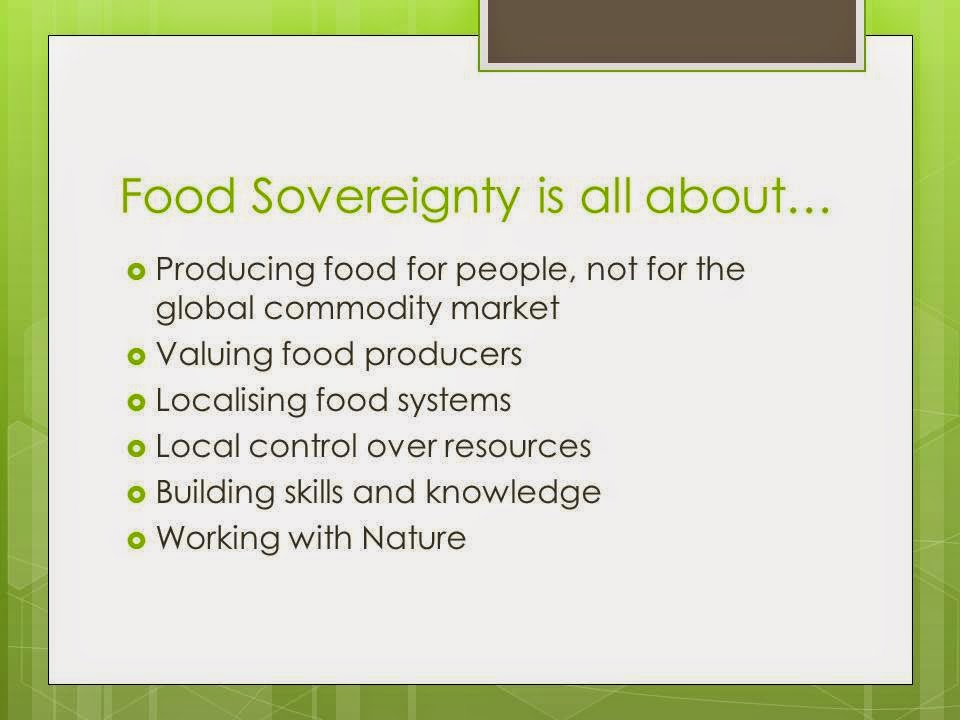
Food sovereignty is about:
  •   Producing food for people, not for the global commodity market
  •   Valuing food producers
  •   Localising food systems
  •   Local control over resources
  •   Building skills and knowledge
  •   Working with Nature


This local food map was made by one of the local groups in Whaingaroa, where my research is based.

Whaingaroa is a dynamic community engaged in activities related to food sovereignty

Groups and initiatives are closely interconnected

There is a strong focus on ‘local’, ‘organic’, ‘sustainable’

There is still a long way to go....
•Supermarket culture: a lot of food is still purchased from the town supermarkets or from Hamilton
•Not enough local food producers yet (more coming?)
•Poverty and social exclusion vs the ‘green bubble’


Interconnectedness is key

Food sovereignty is about relationships


What can we learn from the local food producers of Whaingaroa?
* People can lead incredibly rich lives without much material wealth
* Balancing the economic, social and environmental  - and viewing them as interconnected
* There are strong critiques, here, of the corporate food system: control, ecological damage and exploitation
* People have gotten too disconnected from food: need to reconnect, Food needs to be real
* Food should be: local, sustainably produced, safe and abundant.
* There is a strong focus on supporting local food producers: avoiding competition, working together
* There is also a strong focus on respecting indigenous values and learning from indigenous wisdom


Indigenous systems have been developed alongside ecological systems – necessarily –

We can learn a lot from ecological systems, from the indigenous knowledge systems in our local landscape

Without considering the flows and cycles of ecosystems, without considering ourselves part of them, we cannot move past sustainability as a catchword


Through understanding the interconnectedness we can repair fragmented ontologies, heal rifts and avoid environmental, social and economic exploitation.

Tuesday, June 10, 2014

You can permaculture anything, so how about a thesis?

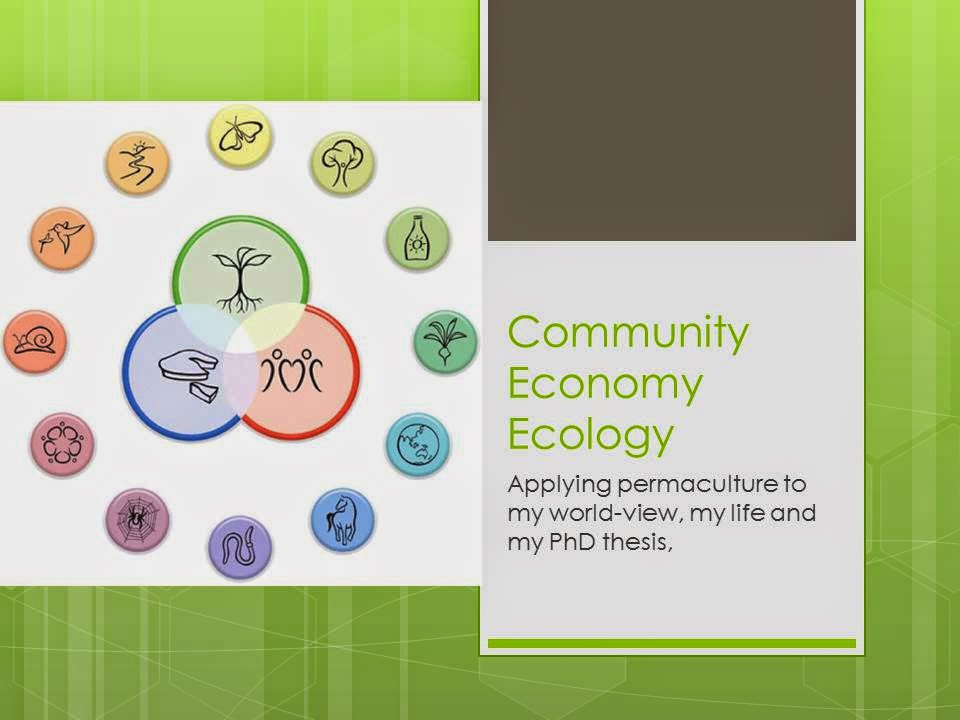
Permaculture is not just about gardening, as many people seem to think. I just completed a Permaculture Design Certificate (PDC) which was very little to do with gardening. I have learnt that permaculture is a good system for designing good systems. It involves a whole lot of principles that can be applied to just about anything, and since I'm doing this PhD thing, I thought I would experiment with applying it to my research. The following is a presentation I did for the PDC.


First of all, I sang a song, because that's an appropriate thing to do, right? It's a song about the Monsanto because that is one of the nasty things that motivated me to look for positive alternatives, so it's totally relevant.


Wait, what is food sovereignty?


So that sounds like it has a lot to do with permaculture to begin with...


Then I tried some funky mind-mapping (not my strong-point), because in permaculture there is this thing with interconnectedness and stuff.


Then I tried looking at the permaculture principles in light of my research


And this thing, which, as it turned out, was totally compatible with my notes already:


And then there's the permaculture flower:


So through this process I realised that I was doing this whole research thing backwards (as I usually do things), so I ended with the question that I should have probably started with:


Monday, October 15, 2012

Ethics

I recently got ethical approval from the University of Waikato Faculty of Arts and Social Sciences Human Research Ethics Committee.  The process involved writing quite a long document to demonstrate that I have enough understanding and sensitivity not to endanger anyone in the course of my research.  It gave me many good opportunities to think about my research and clarify my objectives and resolve some childhood issues to boot.  Anyway.  Part of the ethical process I am going to follow is to write a blog post about ethics (this one).

If you want to know more about the ethics of my PhD research you can contact me using the form below or my email (confustulation (at) gmail (dot) com), alternately you can contact my supervisors: Dr Tom Ryan, email: tryan (at) waikato.ac.nz or Dr Kellie McNeill, email: k.mcneill (at) auckland.ac.nz.

For general information about my research you can read my handy-dandy information sheet:


Shared Lunch: An Ethnography of Food Sovereignty in Whaingaroa and Beyond

Researcher: Isa Ritchie

General Information Sheet


I am currently undertaking a PhD in Anthropology looking at food sovereignty in Whaingaroa and wider New Zealand.  I want to look at grass-roots community-based initiatives that are involved in growing food or redistributing food that would otherwise be wasted, and to investigate how these might relate to the global food sovereignty movement.  I want to look at things such as food foraging, sustainable farming, community gardening, land sharing and wwoofing.

My research involves participating, observing and getting involved with community food-based activities.  I will try to actively help out and not just get in the way.  In doing this I hope to get a really good understanding of what’s going on.  I will also interview people who are involved in these activities to find out more about their thoughts and values.  I will then link this with what I am reading about food sovereignty on a global level. I am doing this research because there is not very much academic literature around this topic at the moment, particularly New Zealand based literature and I think it’s an important topic.

No one is paying for this research but I do have a scholarship from the University of Waikato to help me to do it.  The participants involved in this research may just be doing what they were already doing while I participate and observe; they may casually tell me things they want to tell me or they may sit down with me and answer questions for an hour or so.  All of this is voluntary.  Even if you know me outside of this research please feel no obligation to participate.  Participants decide their own level of involvement.  I want people to participate in this research only if they want to do it.

This research will be published as my thesis, copies will be held at the University of Waikato library, by the Anthropology department, and by me.  A digital copy will also be accessible online.  I hope that this research will lead to formal publications and that information about this can be widely disseminated to inspire other communities.  I am also open to co-creating future publications and presentations with participants if they are interested.  I will also present findings in an appropriate form to the Whaingaroa community.

This research project has been approved by the Human Research Ethics Committee of the Faculty of Arts and Social Sciences. Any questions about the ethical conduct of this research may be sent to the Secretary of the Committee, email fass-ethics@waikato.ac.nz, postal address, Faculty of Arts and Social Sciences, Te Kura Kete Aronui, University of Waikato, Te Whare Wananga o Waikato, Private Bag 3105, Hamilton 3240.

Monday, February 22, 2010

Getting on with it

It's February and I have until November to get everything finished. Some days it seems like 30,000 words isn't enough, other days it seems daunting and I feel pressure to get writing.

1,000 down, 29,000 to go! I'm not in an intensive writing phase just yet. I'm still trying to get my ideas in order.

Here's the general outline of my research:

Literature review:

  1. Traditional nutrition: General overview of nourishing traditions and the research of Dr. Weston A. Price

  2. The Weston A. Price Foundation: What has been written about WAPF – academically? Non-academic? Written by them? (I'm struggling with this at the moment. Very little has been written about WAPF academically)

  3. Key ideas of the WAPF – case study: fat (I've done some research on this before)

  4. Other similar movements, compare key ideas: Bio-dynamic, organic, slow food, etc.

  5. Movement in a global context - new social movements

  6. Blogs – what they are etc.


Empirical research:

  1. Methodology

  2. Blog research (I will expand on this later)

Now for some food...


Sourdough french toast with maple syrup and yogurt


This recipe is very simple, almost so simple that I don't need to explain it at all.

Ingredients:
Two eggs
1/4 cup cream
Six small pieces of sourdough bread
Butter, salt and cinnamon to taste
Maple syrup and yogurt

Mix the eggs with the cream, add a pinch of salt and sprinkle of cinnamon. Soak bread in the egg mixture and then fry in butter until golden. Serve with maple syrup and yogurt. Eat immediately!

Friday, December 25, 2009

The Nourishing Revolution

It didn't happen over night, but over the last few years farmer's markets have sprung up out of nowhere. In Westernised countries where all the food was thought by small children to come from the supermarket we have seen a revival of the home vegetable garden. Free range eggs have become prevalent, even popular and in countries like the United States where it seemed for a while that cattle feed lots had replaced the small farms for good we have watched as pastured meat has become a fast growing market - for those who can afford it.

In New Zealand we are lucky that it's still cheaper to raise cows out in the paddock than it is to feed them corn that they're not able to easily digest. But almost all the other problems with modern food are just as big and bad here. We have supermarket shelves stocked with packaged items, unreadable ingredients lists masquerading as food. Most of our chicken has been "barn raised" for years, but it's good to see that things are starting to change.

I'm starting this blog to correspond to research I am undertaking for my Masters degree in sociology. You are welcome to comment and participate and your contributions may be useful in my research. My topic is, if you haven't worked it out already, about this nourishing revolution. It's about people getting back into traditional food and learning how to prepare it - especially people in countries like the US and NZ where most of us have a few generations of gradually losing touch with real food and are now finding it again. Of course, the work of Mary Enig and Sally Fallon, the Weston A. Price Foundation and Nourishing traditions have a lot to do with this.

For me food is a passion and a hobby. The best food is delicious and healthy, fresh, pure and ethical. It leaves a pleasant taste in your mouth. Food is currently my main form of escapism (some people drink or read romance novels - I cook). For all these reasons and more I have decided to focus on food for my thesis.


Free range chicken and avocado salad with olives, organic apple, feta and cucumbers.