This post is based on a presentation I did at a sustainability symposium at the University of Waikato a few weeks ago.
Abstract:
Food sovereignty and agroecology have been the focus of much academic attention in recent years, although very little has been published on these topics in a New Zealand context. These paradigms have been instrumental in highlighting multifaceted problems of social and environmental exploitation emerging from the existing industrialised food systems and identifying more sustainable solutions. This presentation draws on preliminary findings from doctoral research focused on food sovereignty in New Zealand. Qualitative data was were gathered through ethnographic fieldwork and in-depth interviews with people who produce, organise and distribute local food in a small coastal New Zealand township, as well as in several contrasting settings. It presents diverse understandings around organic and local food, environmental protection, community resilience and living economies. The findings are that genuine pathways to sustainability are possible through agricultural models based on ecosystems and indigenous knowledge systems, and through the proliferation and support of small-scale community initiatives.

Sustainability
has become a catchword…
A
linguistic representation of a cultural shift in
perspective that has increasingly necessary in the face of emerging global
crises – climate, food, waste, energy and inequality
This wave has reached the point where
it’s no longer just a few hippies waving placards, it is increasingly ubiquitous

The movement that first became mainstream
for my generation with the likes of Captain Planet has now reached critical
mass
But does this mean the words are being
over-used? Green-washed?
Has sustainability lost meaning? Has it
been corporatised?

A
critical perspective is important here…
While
there is plenty to be critical of, it is also
helpful to look for solutions, to find working models and inspiration
Genuine sustainability must come from the
grass-roots, upward. It must be holistic and multi-faceted.
Economic, social and environmental –
genuine sustainability is synonymous with healthy interconnected ecosystems.

Agroecology is a
whole-systems approach to agriculture and food systems development based on
traditional knowledge, alternative agriculture, and local food system
experiences: linking
ecology, culture, economics, and society to sustain agricultural production,
healthy environments, and viable food and farming communities. It's also a
less ‘hippy’ term for permaculture

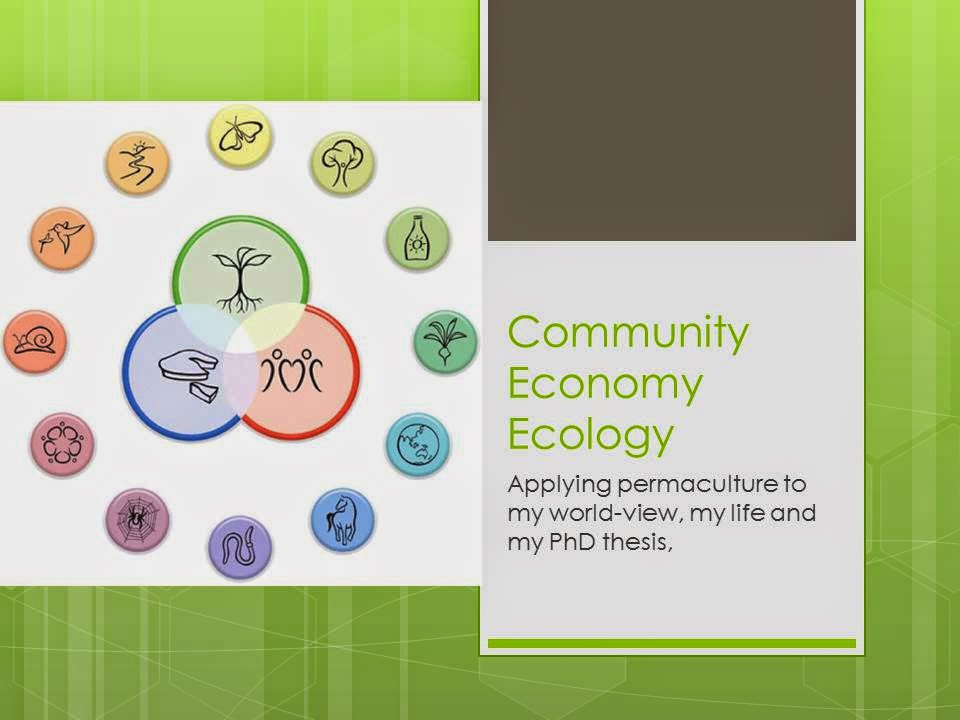
Permaculture
(permanent agriculture/culture) is the conscious design and maintenance of
agriculturally productive ecosystems which have the diversity, stability, and
resilience of natural ecosystems
Consciously
designed landscapes which mimic the patterns and relationships found in nature,
while yielding an abundance of food, fibre and energy for provision of local
needs.
It
is a system which
can
be applied to anything – society/community, economics…

Sparked
in 1996 by Vía Campesina, an
international peasant movement representing more than 180 international
organisations advocating for peasants, migrant agricultural workers, indigenous
food providers and small-scale farmers.
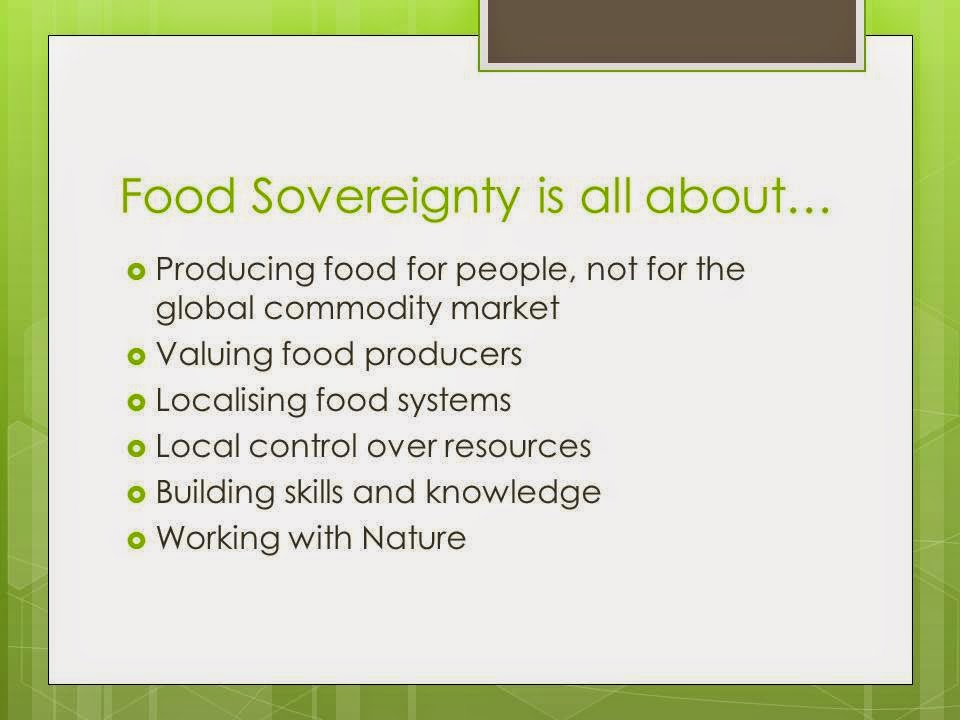
Food sovereignty is about:
- Producing food for people, not for the global commodity market
- Valuing food producers
- Localising food systems
- Local control over resources
- Building skills and knowledge
- Working with Nature

This local food map was made by one of the local groups in Whaingaroa, where my research is based.
Whaingaroa
is a dynamic community engaged in activities related to food sovereignty
Groups
and initiatives are closely interconnected
There is a strong
focus on ‘local’, ‘organic’, ‘sustainable’
There
is still a long way to go....
•Supermarket
culture: a lot of food is still purchased from the town supermarkets or from
Hamilton
•Not
enough local food producers yet (more coming?)
•Poverty
and social exclusion vs the ‘green bubble’

Interconnectedness is key
Food sovereignty is about relationships

What
can we learn from the local food producers of Whaingaroa?
* People can lead incredibly rich lives without much material wealth
* Balancing the economic, social and
environmental - and viewing them as
interconnected
* There are strong
critiques, here, of the corporate food system: control, ecological damage and
exploitation
* People
have gotten too disconnected from food: need to reconnect, Food needs to be
real
* Food
should be: local, sustainably produced, safe and abundant.
* There is a strong focus on supporting
local food producers: avoiding competition, working together
* There is also a strong focus on respecting
indigenous values and learning from indigenous wisdom

Indigenous
systems have been developed
alongside ecological systems – necessarily –
We
can learn a lot from ecological systems, from the
indigenous knowledge systems in our local landscape
Without considering the flows and cycles
of ecosystems, without considering ourselves part of them, we cannot move past
sustainability as a catchword

Through
understanding the interconnectedness we can repair fragmented ontologies, heal
rifts and avoid environmental, social and economic exploitation.