Showing posts with label PhD. Show all posts

Sunday, July 15, 2018

Shared Lunch: An Ethnography of Food Sovereignty in Whaingaroa and Beyond (my PhD thesis)

Image credit: Elaine Casap, Unspash

It has been a while since I've posted here. I completed my PhD in 2017 and I'm pleased to report that the examiners loved it! The final exam was a wonderful experience and it was great to have the support of close friends and family with me for the process.

Here are the quotes from the examiners:

Thank you for devoting you time and energy into this timely, relevant and enlightening thesis...This is a rare find.
Once I found time to devote to it, I could not put it down. It is practical, professional, personal and political. It calls for action without being a ‘biased activist’ type of thesis.
It simply needs to be published and shared with wider audiences as it provides a useful template for researching community development and grassroots actions…
Local focus is balanced with a bigger picture and current global issues in the world which makes this thesis timely and relevant. 
Ksenija Napan  -  Associate Professor, Massey University

Let me first aknowlege that this is one of the best-written dissertations I have ever read in over 30 years at this!
I was skeptical at first about Ritchie’s ability to “draw together the threads” and had to read quite far into the document to begin to see it – but then it was there!
In this way, the reader was able to slowly integrate the bits, possibly much like the researcher had sone, and it worked beautifully. It almost reads like a novel, it is so interesting, and I very much enjoyed reading it!
Grace Ann Rosile,  -  Professor, New Mexico State University

And here is the beginning of the abstract:

Food presents complex interconnectedness between inner and outer; social and political; culture and biochemistry; values and practices; tradition and innovation; wealth and poverty; the global, local and highly personal. Amid this multifaceted intersection vast bodies of contemporary academic literature have emerged. This study is an ethnography of alternative food networks; of food sovereignty and social economics. More specifically it is an ethnography of a community of small-scale local food providers in Whaingaroa, a small coastal township in Aotearoa [New Zealand]. Through the lenses provided by perspectives of these food providers, the global corporate food system is critiqued. Through their everyday practices, alternatives have been developed which offer potential solutions to widely recognised problems associated with environmental and social exploitation. These problems are largely attributed to the current dominant global systems of corporate capitalism, including the dominant systems of food production, consumption and disposal.


You can read the full thesis here.
Thank you for following my research journey on this blog. It has really helped to shape my thinking around my Masters and PhD research.

What's next?
I've just published my second novel, Fishing for Māui, which has themes around food, family and mental illness. I drew a lot from my Masters research in writing this novel and I'm so pleased to finally be publishing it! You can read more about it on my website. It is available from the distributor, on Amazon, MeBooks, Bookdepository, Smashwords, and all good bookstores and libraries in New Zealand!

Saturday, June 27, 2015

Draft abstract

I have been working on an abstract (brief summary at the beginning) for my thesis.

Abstract

This is an ethnography of alternative food networks; of food sovereignty social economics. More specifically it is an ethnography of a community of small-scale local food providers in a small coastal township in Aotearoa [New Zealand].  Through the lens provided by the values and perspectives of these food providers, the global corporate food system is critiqued. Through their practices, small-scale solutions and alternatives are constructed to the widely recognised problems associated with the environmental and social exploitation attributed to the current dominant systems.

I came to this research with a deep commitment to social justice, and a deep concern for our ecosystems on this planet. My focus on food has been influenced by experiences of food insecurity in my childhood and observations of abject poverty; by ongoing negotiations in my life around food as healthy, ethical and affordable; by an acute awareness of the ruthless social and environmental exploitation involved in the corporate food industry; by a deliberately cultivated attitude of optimism, and by a strong compulsion to search for and promote more sustainable models of food production.

Over the course of this research I learned about various food democratisation initiatives throughout the country. These included community gardens, seed banks, free shops, dumpster diving, land-sharing, food co-ops and other forms of food hubs, courses, workshops and internships, sustainability focussed intentional communities and eco-villages, revivals of traditional Māori gardening, groups focussed on planting public fruit trees, groups focussed on harvesting fruit that would otherwise go to waste, and wild foraging initiatives, among others. I also learned about initiatives based in various different countries, from the car-park community gardens in the largely deserted urban slums of Detroit to the allotment gardens of Hawaii.  On some level, it is evident that all these small-scale local initiatives are connected, if only in that they are a response by community to the tensions of struggle and scarcity created by the globalising corporate system. They present a logical, even obvious, response based on the minimal agency that people do have in a world where resources and power is becoming more and more concentrated ‘in the hands of the few’. They present a deliberate focus on solutions, and on what is possible and achievable by small groups of people with minimal resources, and they present a protest against the alienation inflicted by the global corporate food system.  I argue that these food-based initiatives are connected, not only with food sovereignty, but also with movements towards localised economies and alternative economics, such as Living Economies. They are connected with what has been called the ‘Global Justice Movement’, which protests corporate and government exploitation.


Thoughts?

Saturday, March 14, 2015

Pathways to Sustainability through Food Sovereignty and Agroecology: a Holistic Approach


This post is based on a presentation I did at a sustainability symposium at the University of Waikato a few weeks ago.

Abstract:
Food sovereignty and agroecology have been the focus of much academic attention in recent years, although very little has been published on these topics in a New Zealand context. These paradigms have been instrumental in highlighting multifaceted problems of social and environmental exploitation emerging from the existing industrialised food systems and identifying more sustainable solutions. This presentation draws on preliminary findings from doctoral research focused on food sovereignty in New Zealand. Qualitative data was were gathered through ethnographic fieldwork and in-depth interviews with people who produce, organise and distribute local food in a small coastal New Zealand township, as well as in several contrasting settings. It presents diverse understandings around organic and local food, environmental protection, community resilience and living economies. The findings are that genuine pathways to sustainability are possible through agricultural models based on ecosystems and indigenous knowledge systems, and through the proliferation and support of small-scale community initiatives.

Sustainability has become a catchword…

A linguistic representation of a cultural shift in perspective that has increasingly necessary in the face of emerging global crises – climate, food, waste, energy and inequality

This wave has reached the point where it’s no longer just a few hippies waving placards, it is increasingly ubiquitous


The movement that first became mainstream for my generation with the likes of Captain Planet has now reached critical mass

But does this mean the words are being over-used? Green-washed?

Has sustainability lost meaning? Has it been corporatised?


A critical perspective is important here…

While there is plenty to be critical of, it is also helpful to look for solutions, to find working models and inspiration

Genuine sustainability must come from the grass-roots, upward. It must be holistic and multi-faceted.

Economic, social and environmental – genuine sustainability is synonymous with healthy interconnected ecosystems.


Agroecology is a whole-systems approach to agriculture and food systems development based on traditional knowledge, alternative agriculture, and local food system experiences: linking ecology, culture, economics, and society to sustain agricultural production, healthy environments, and viable food and farming communities. It's also a less ‘hippy’ term for permaculture


Permaculture (permanent agriculture/culture) is the conscious design and maintenance of agriculturally productive ecosystems which have the diversity, stability, and resilience of natural ecosystems

Consciously designed landscapes which mimic the patterns and relationships found in nature, while yielding an abundance of food, fibre and energy for provision of local needs.

It is a system which can be applied to anything – society/community, economics…


Sparked in 1996 by Vía Campesina, an international peasant movement representing more than 180 international organisations advocating for peasants, migrant agricultural workers, indigenous food providers and small-scale farmers.

Food sovereignty is about:
  •   Producing food for people, not for the global commodity market
  •   Valuing food producers
  •   Localising food systems
  •   Local control over resources
  •   Building skills and knowledge
  •   Working with Nature


This local food map was made by one of the local groups in Whaingaroa, where my research is based.

Whaingaroa is a dynamic community engaged in activities related to food sovereignty

Groups and initiatives are closely interconnected

There is a strong focus on ‘local’, ‘organic’, ‘sustainable’

There is still a long way to go....
Supermarket culture: a lot of food is still purchased from the town supermarkets or from Hamilton
Not enough local food producers yet (more coming?)
Poverty and social exclusion vs the ‘green bubble’


Interconnectedness is key

Food sovereignty is about relationships


What can we learn from the local food producers of Whaingaroa?
* People can lead incredibly rich lives without much material wealth
* Balancing the economic, social and environmental  - and viewing them as interconnected
* There are strong critiques, here, of the corporate food system: control, ecological damage and exploitation
* People have gotten too disconnected from food: need to reconnect, Food needs to be real
* Food should be: local, sustainably produced, safe and abundant.
* There is a strong focus on supporting local food producers: avoiding competition, working together
* There is also a strong focus on respecting indigenous values and learning from indigenous wisdom


Indigenous systems have been developed alongside ecological systems – necessarily –

We can learn a lot from ecological systems, from the indigenous knowledge systems in our local landscape

Without considering the flows and cycles of ecosystems, without considering ourselves part of them, we cannot move past sustainability as a catchword


Through understanding the interconnectedness we can repair fragmented ontologies, heal rifts and avoid environmental, social and economic exploitation.

Tuesday, June 10, 2014

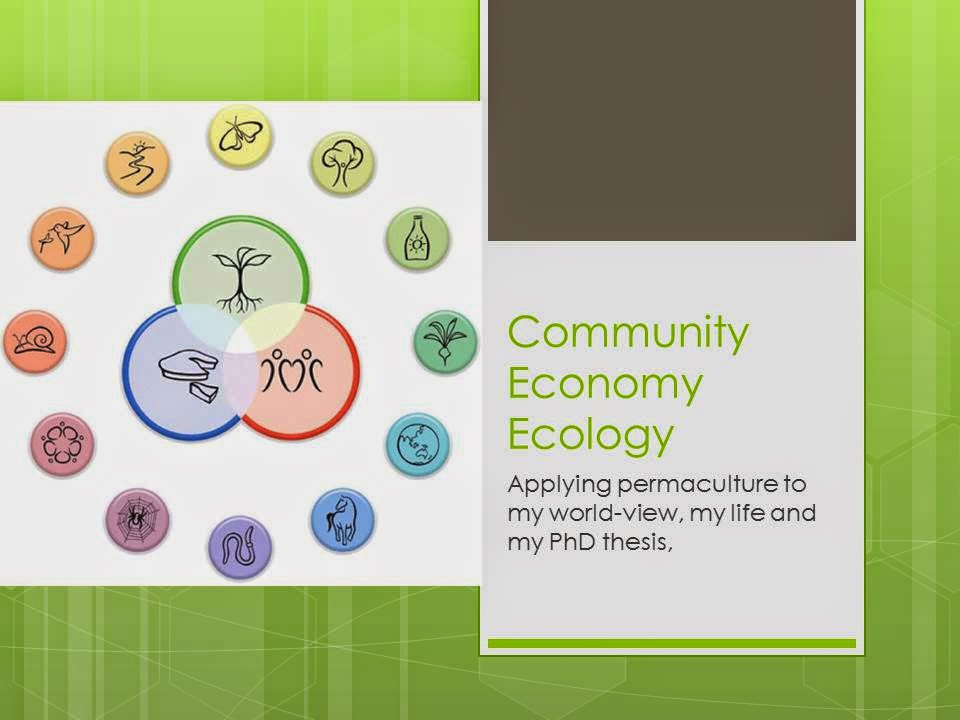
You can permaculture anything, so how about a thesis?

Permaculture is not just about gardening, as many people seem to think. I just completed a Permaculture Design Certificate (PDC) which was very little to do with gardening. I have learnt that permaculture is a good system for designing good systems. It involves a whole lot of principles that can be applied to just about anything, and since I'm doing this PhD thing, I thought I would experiment with applying it to my research. The following is a presentation I did for the PDC.


First of all, I sang a song, because that's an appropriate thing to do, right? It's a song about the Monsanto because that is one of the nasty things that motivated me to look for positive alternatives, so it's totally relevant.


Wait, what is food sovereignty?


So that sounds like it has a lot to do with permaculture to begin with...


Then I tried some funky mind-mapping (not my strong-point), because in permaculture there is this thing with interconnectedness and stuff.


Then I tried looking at the permaculture principles in light of my research


And this thing, which, as it turned out, was totally compatible with my notes already:


And then there's the permaculture flower:


So through this process I realised that I was doing this whole research thing backwards (as I usually do things), so I ended with the question that I should have probably started with:


Tuesday, February 11, 2014

Is 'Food Sovereignty' Relevant in New Zealand?


This is one of the major questions I'm currently pondering in my thesis looking at food sovereignty in New Zealand: Is the term relevant here, and how is it relevant?  It is rarely used here, even among food activists, local food producers and people involved in community food initiatives, but the people who have heard of it, who I have spoken to, resonate with it, and the people who haven't heard of it are interested to find out more.

The term 'food sovereignty' came out of the Via Campensina conferences in 1993 and 1996. Via Campesina are an  international peasant movement representing small farmers, migrant workers and indigenous people who want to have/protect the right to grow food. They were disillusioned with 'food security' (a term that is commonly used here) because the United Nations was working with big corporations like Monsanto to grow many tonnes of genetically modified corn for 'food security'. These big companies tend to push indigenous people off their land, exploit migrant workers and sue small farmers for saving seeds which are contaminated with the corporation's patented DNA. Not food security at all, just mass production.

Via Campesina deliberately constructed 'food sovereignty' to be about people and communities having the access to land to grow food. It is constructed so as to avoid being co-opted by corporations or other large, powerful organisations. It embodies principles of both social and environmental justice, check them out here.

So there is a bunch of academic research on food sovereignty in all sorts of places from disenfranchised indigenous people in South America to the ethnic minorities in the United States, from the anti GE movement in the EU to food struggles Malawi. This is a global movement so it makes sense that it would be relevant in Aotearoa, although there is very little literature. I have come across one publication looking at the term in New Zealand, so far, which focuses on Te Waka Kai Ora, the Maori organics organisation, and there are a bunch of non-academic references including Facebook groups and websites.  The question of privilege arises because some of the academic criticism of food sovereignty complains that the movement glorifies people's empowerment over food rather than addressing the reality that most of the world's rural poor don't have a choice outside of subsistence living.  In 'developed' countries it is more clearly a choice. I want to have a discussion about this, what do you think:


  • Is food sovereignty relevant in New Zealand? 
  • Do we have a food sovereignty movement?
  • What does food sovereignty mean in NZ and what does it look like?
  • How is it relevant?
  • How do we deal with the uncomfortable issues around privilege? 
  • In using the term are we co-opting a peasant movement to suit our relatively privileged ethics?
  • We do have real poverty in New Zealand and it often comes with social alienation. How can the food sovereignty movement (if there is one) address this? 
Please join in the discussion by posting a comment below.

Monday, October 15, 2012

Ethics

I recently got ethical approval from the University of Waikato Faculty of Arts and Social Sciences Human Research Ethics Committee.  The process involved writing quite a long document to demonstrate that I have enough understanding and sensitivity not to endanger anyone in the course of my research.  It gave me many good opportunities to think about my research and clarify my objectives and resolve some childhood issues to boot.  Anyway.  Part of the ethical process I am going to follow is to write a blog post about ethics (this one).

If you want to know more about the ethics of my PhD research you can contact me using the form below or my email (confustulation (at) gmail (dot) com), alternately you can contact my supervisors: Dr Tom Ryan, email: tryan (at) waikato.ac.nz or Dr Kellie McNeill, email: k.mcneill (at) auckland.ac.nz.

For general information about my research you can read my handy-dandy information sheet:


Shared Lunch: An Ethnography of Food Sovereignty in Whaingaroa and Beyond

Researcher: Isa Ritchie

General Information Sheet


I am currently undertaking a PhD in Anthropology looking at food sovereignty in Whaingaroa and wider New Zealand.  I want to look at grass-roots community-based initiatives that are involved in growing food or redistributing food that would otherwise be wasted, and to investigate how these might relate to the global food sovereignty movement.  I want to look at things such as food foraging, sustainable farming, community gardening, land sharing and wwoofing.

My research involves participating, observing and getting involved with community food-based activities.  I will try to actively help out and not just get in the way.  In doing this I hope to get a really good understanding of what’s going on.  I will also interview people who are involved in these activities to find out more about their thoughts and values.  I will then link this with what I am reading about food sovereignty on a global level. I am doing this research because there is not very much academic literature around this topic at the moment, particularly New Zealand based literature and I think it’s an important topic.

No one is paying for this research but I do have a scholarship from the University of Waikato to help me to do it.  The participants involved in this research may just be doing what they were already doing while I participate and observe; they may casually tell me things they want to tell me or they may sit down with me and answer questions for an hour or so.  All of this is voluntary.  Even if you know me outside of this research please feel no obligation to participate.  Participants decide their own level of involvement.  I want people to participate in this research only if they want to do it.

This research will be published as my thesis, copies will be held at the University of Waikato library, by the Anthropology department, and by me.  A digital copy will also be accessible online.  I hope that this research will lead to formal publications and that information about this can be widely disseminated to inspire other communities.  I am also open to co-creating future publications and presentations with participants if they are interested.  I will also present findings in an appropriate form to the Whaingaroa community.

This research project has been approved by the Human Research Ethics Committee of the Faculty of Arts and Social Sciences. Any questions about the ethical conduct of this research may be sent to the Secretary of the Committee, email fass-ethics@waikato.ac.nz, postal address, Faculty of Arts and Social Sciences, Te Kura Kete Aronui, University of Waikato, Te Whare Wananga o Waikato, Private Bag 3105, Hamilton 3240.